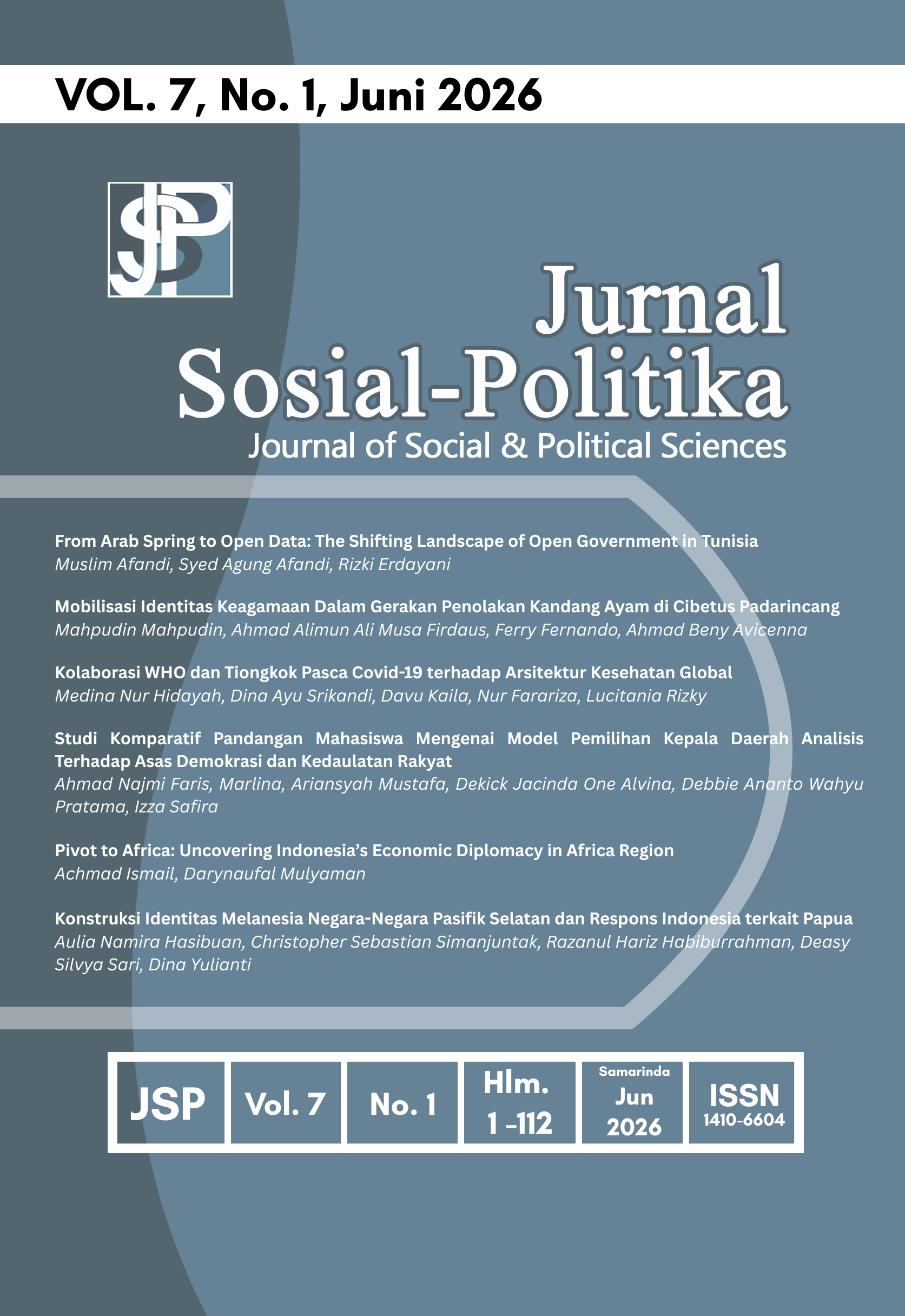
From Arab Spring to Open Data: The Shifting Landscape of Open Government in Tunisia
DOI:
https://doi.org/10.54144/z4cqnp96Keywords:
Open Government, Open Government Partnership, TunisiaAbstract
This study explores the evolution of open government in Tunisia by mapping scholarly literature published between 2011 and 2025, coinciding with the country’s accession to the Open Government Partnership. Using bibliometric analysis with VOSviewer, the research examines review articles retrieved via Publish or Perish and indexed in Google Scholar, focusing on transparency, public participation, and accountability. The analysis identifies three thematic clusters: fiscal transparency and access to information, public participation and democratic innovation, and institutional accountability and digital governance. These clusters reflect the priorities of both government and civil society, while highlighting Tunisia’s role as the first MENA country to join the OGP. Findings reveal that academic discourse has shifted from exploratory studies after the Arab Spring to more consolidated analyses of implementation and institutionalization. Nonetheless, challenges remain, including institutional fragmentation, political instability, and limited civic capacity to influence policymaking. This study contributes by providing a systematic overview of research trends and thematic priorities, and by offering policy-relevant recommendations. Strengthening open data practices, promoting substantive citizen participation, and enhancing accountability through independent oversight and integrated digital governance are proposed as key strategies to advance democratic governance in Tunisia and the broader MENA region.
Downloads
Published
Issue
Section
License
Copyright (c) 2026 Jurnal Sosial-Politika

This work is licensed under a Creative Commons Attribution-ShareAlike 4.0 International License.