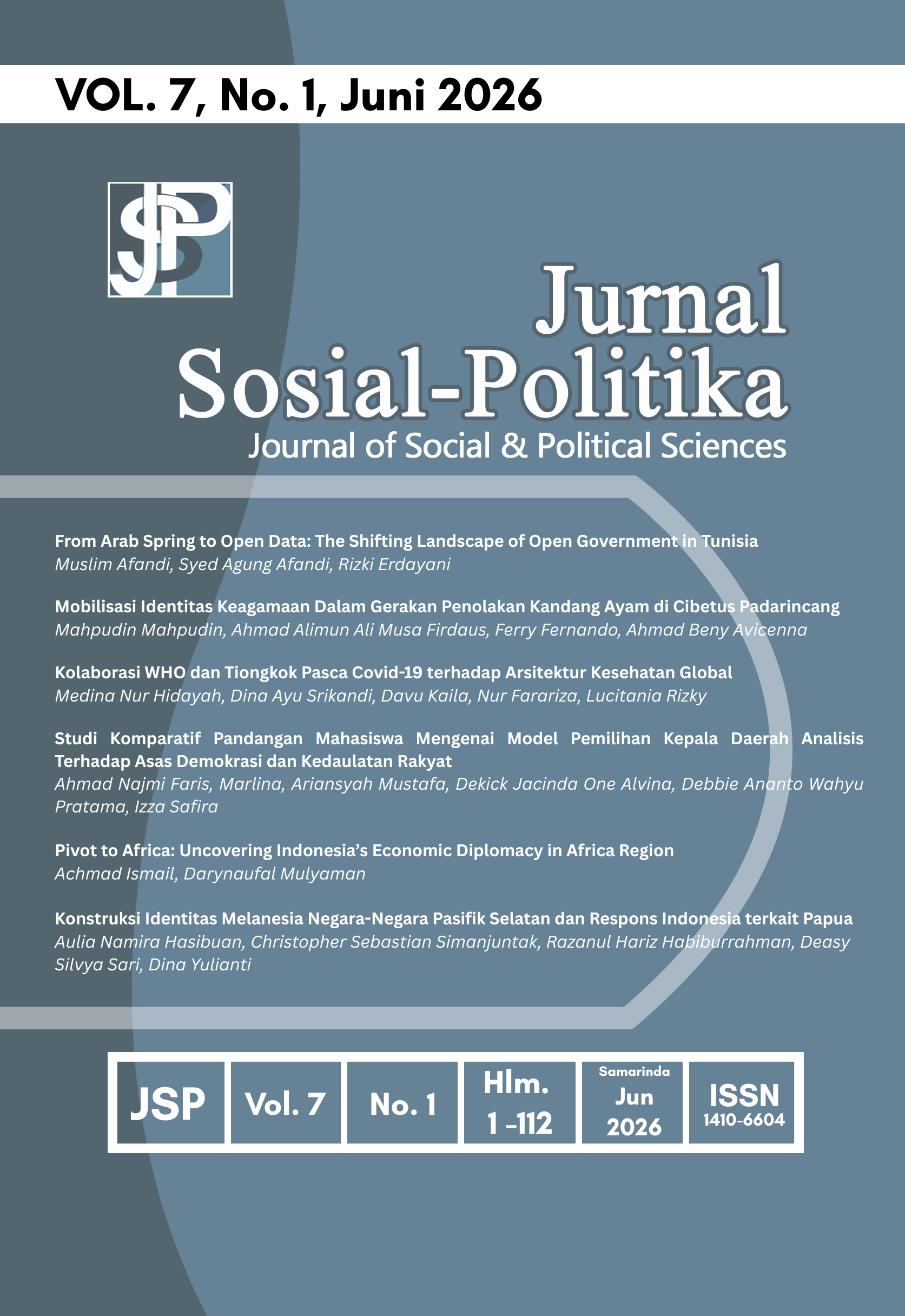
Kolaborasi WHO dan Tiongkok Pasca Covid-19 terhadap Arsitektur Kesehatan Global
DOI:
https://doi.org/10.54144/mxsfrn32Keywords:
Global health architecture, World Health Organization, Tiongkok, COVID-19, Liberal institutionalismAbstract
The COVID-19 pandemic exposed fundamental weaknesses in the existing global health architecture and highlighted the limitations of national responses to transboundary health crises. Persistent post-pandemic challenges, including long COVID, mental health crises, disruptions to non-communicable disease services, and unequal access to vaccines, demonstrate the need for effective international coordination in global health governance. This study examines the dynamics of collaboration between the World Health Organization (WHO) and China in the post-COVID-19 period and analyzes its implications for the global health architecture. Using a qualitative research design with descriptive-analytical methods, this study relies on secondary data collected through library research, including official WHO documents, International Health Regulations (IHR 2005), World Health Assembly reports, and relevant academic literature. The analysis is guided by the liberal institutionalism approach to understand how international institutions and regimes shape state behavior through norms, rules, and cooperative mechanisms. The findings indicate that WHO functions as a global health regime that influences state behavior primarily through normative authority and institutional legitimacy rather than coercive power. The interaction between WHO and China illustrates both the effectiveness and limitations of the global health regime, as cooperation remains essential but is often shaped by political negotiation and geopolitical considerations. This study concludes that strengthening WHO’s institutional capacity and reinforcing compliance mechanisms within the IHR are crucial for building a more resilient and credible global health architecture in the post-pandemic era.
Downloads
Published
Issue
Section
License
Copyright (c) 2026 Jurnal Sosial-Politika

This work is licensed under a Creative Commons Attribution-ShareAlike 4.0 International License.